Subscribe to our newsletter

ICYMI: Nigeria’s Inflation Rate Drops To 15.10%
Nigeria’s headline inflation rate dipped marginally to 15.1 per cent in January 2026 from 15.15 per cent recorded in December 2025, the National Bureau of Statistics (NBS) disclosed on Monday. In its previous report, the statistics agency introduced a revised methodology which it said more accurately captures prevailing market prices. The latest figures were released ahead of the forthcoming Monetary Policy Committee meeting of the Central Bank of Nigeria, scheduled for February 23–24, 2026. According to the NBS, the headline inflation rate in January declined by 0.05 percentage points compared to December 2025. On a year-on-year basis, inflation dropped significantly by 12.51 percentage points from the 27.61 per cent recorded in January 2025. On a month-on-month basis, headline inflation stood at 2.88 per cent, compared to 0.54 per cent in December 2025, reflecting a slower increase in average price levels. Food inflation, which represents the largest component of household expenditure, recorded a notable moderation during the month. Year-on-year, food inflation eased to 8.89 per cent, down by 20.73 percentage points from 29.63 per cent in January 2025. Month-on-month, food inflation declined to 6.02 per cent from 0.36 per cent in December 2025. The NBS attributed the easing to price reductions in major food items such as water yam, eggs, green peas, groundnut oil, soya beans, palm oil, maize, guinea corn, beans, beef, melon (egusi), cassava tubers and white cowpeas, among others. The 12-month average food inflation rate fell to 20.29 per cent in January 2026, compared to 38.47 per cent recorded in the corresponding period last year — a decrease of 18.18 percentage points. Core inflation, which excludes volatile agricultural produce and energy prices, stood at 17.72 per cent year-on-year in January 2026, down from 25.27 per cent in January 2025. On a month-on-month basis, core inflation eased to 1.69 per cent from 0.58 per cent in December 2025. The 12-month average core inflation rate also moderated to 22.84 per cent, compared to 27.24 per cent recorded a year earlier. In urban areas, inflation slowed to 15.36 per cent year-on-year from 29.45 per cent in January 2025, while month-on-month urban inflation stood at 2.72 per cent. However, the 12-month average urban inflation rate rose to 22.30 per cent. In rural areas, inflation declined to 14.44 per cent year-on-year, down from 25.04 per cent in January 2025. On a month-on-month basis, rural inflation dropped to 3.29 per cent, while the 12-month average fell to 21.03 per cent from 30.79 per cent recorded a year earlier.
2/17/2026, 7:11:37 AM
views 9704
FG Orders NAFDAC To Suspend Sachet Alcohol Ban
The Federal Government has instructed the National Agency for Food and Drug Administration and Control (NAFDAC) to halt all enforcement activities connected to the proposed ban on sachet alcohol and 200ml PET bottle alcoholic beverages. It also directed the agency to immediately cease the sealing of factories and warehouses over the matter. The directive was conveyed in a statement released on Wednesday in Abuja by the Special Adviser on Public Affairs to the Secretary to the Government of the Federation, Terrence Kuanum. According to Kuanum, the decision followed a joint intervention by the Office of the Secretary to the Government of the Federation and the Office of the National Security Adviser, which expressed concerns about the security implications of continuing enforcement actions without a fully implemented National Alcohol Policy in place. “Accordingly, all actions, decisions, or enforcement measures relating to the ongoing ban on sachet alcohol are to be suspended pending the final consultations and implementation of the National Alcohol Policy and the issuance of a final directive,” the statement read. He said although the National Alcohol Policy had been signed by the Federal Ministry of Health in line with the directive of President Bola Tinubu, both offices insisted that NAFDAC must refrain from all enforcement measures until the policy is fully implemented and further directives are issued. The government said such measures include factory shutdowns, warehouse sealing and public emphasis on the sachet alcohol ban. The statement noted that the continued sealing of warehouses and what it termed a “de facto ban” on sachet alcohol products, in the absence of a harmonised policy framework, was already disrupting economic activities and creating security concerns, particularly due to its effects on employment, supply chains and informal distribution networks across the country. Kuanum explained that the stance reaffirmed an earlier directive issued by the Office of the Secretary to the Government of the Federation (SGF) in December 2025, which suspended all measures related to the proposed ban pending wider consultations and a final resolution. He further disclosed that the SGF’s office had received a letter dated November 13, 2025, from the House of Representatives Committee on Food and Drugs Administration and Control, expressing reservations about NAFDAC’s proposed enforcement steps and citing existing resolutions of the National Assembly on the matter. The letter, referenced NASS/10/HR/CT.53/77 and signed by the committee’s Deputy Chairman, Hon. Uchenna Okonkwo, highlighted concerns over the agency’s planned actions and drew attention to prior resolutions of the National Assembly. The Federal Government stated that it is currently reviewing the legislative resolutions alongside public health considerations, economic implications and broader national interest issues surrounding the controversy. It added that the involvement of the Office of the National Security Adviser underscored that the matter had transcended routine regulatory concerns, cautioning that premature enforcement without a coordinated policy framework could destabilise communities, aggravate unemployment and heighten security risks. The government assured Nigerians and industry stakeholders that a conclusive decision would be announced after thorough consultations and inter-agency coordination, with due regard for public health, economic stability and national security.
2/11/2026, 11:24:26 AM
views 8359
Nigeria’ll Continue Borrowing To Fund N25.91trn Budget Deficit — Senate
Despite widespread public criticism over Nigeria’s rising debt profile, the Senate yesterday reaffirmed that the country would continue to borrow to cover its huge budget deficit. The upper chamber also pledged to put an end to the long-standing practice of rolling over unexecuted budgets, cautioning Ministries, Departments and Agencies (MDAs) to prepare for tougher oversight. It further announced that the National Assembly would no longer approve extensions of budget implementation periods, stressing that the 2026 Appropriation Act would be executed under strict timelines, enhanced supervision and improved fiscal discipline. Speaking at a public hearing on the 2026 Appropriation Bill organised by the Senate Committee on Appropriations, the committee’s chairman, Senator Olamilekan Adeola (APC, Ogun West), said borrowing had become inevitable due to limited government revenue and enormous development demands. He stated: “The National Assembly will no longer approve budget extensions. We must enforce discipline in our budgeting process, ensure strict compliance with appropriation timelines and strengthen coordination between policy formulation and implementation.” While acknowledging sustained public opposition to borrowing, Adeola said Nigeria’s infrastructure deficit and development needs left the government with few alternatives, adding that the key concern was not borrowing itself, but how budget deficits are financed. “Nigeria cannot help but keep borrowing because revenue inflows are unpredictable and development needs are enormous. What matters is how we borrow and how we fund our deficits,’’ he said. He said Nigeria must honour its obligations to protect its credit rating and international standing, adding that to avoid crowding out private sector credit, government was deliberately limiting domestic borrowing and exploring alternatives such as asset optimisation, privatisation, Public-Private Partnerships, PPPs, joint venture asset leveraging and Eurobond issuances. “Government is deliberately avoiding excessive domestic borrowing that could crowd out private sector credit. Instead, we are exploring external financing, asset sales and privatisation to bridge revenue gaps,’’ he said. On the 2026 budget, estimated at ¦ 58.47 trillion, Adeola described it as a “Budget of Consolidation,” anchored on subsidy removal, tax reforms, public finance restructuring and electricity sector reforms. He warned that the success of the budget would depend on effective implementation and people-centred outcomes. The lawmaker disclosed that projected revenue stood at N33.19 trillion, leaving a deficit of about N 25.27 trillion. According to him, debt servicing is projected at N15.90 trillion, while the proposed capital expenditure of N23.21 trillion underscores the government’s emphasis on infrastructure development and productivity. Adeola cautioned heads of Ministries, Departments and Agencies (MDAs) to treat budget defence with utmost seriousness, warning that any inability to adequately defend proposals could result in funds being reallocated.
2/10/2026, 7:49:35 AM
views 8226
CBN, NCC Propose 30mins Timeline For Refund On Failed Airtime, Data Purchases
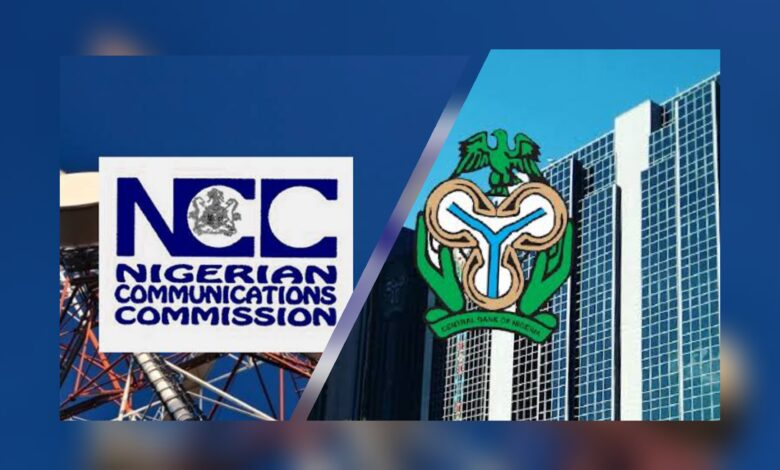
In a sweeping consumer-protection move, the Central Bank of Nigeria (CBN) and the Nigerian Communications Commission (NCC) have proposed a mandatory 30-minute refund window for subscribers affected by failed airtime and data purchase transactions. The proposal is outlined in the *Exposure Draft of the Joint CBN–NCC Framework for Resolution of Failed Airtime and Data Purchase Transactions*, released on Monday. The draft is designed to resolve recurring complaints from bank customers whose accounts are debited without receiving airtime or data from Mobile Network Operators (MNOs). Signed by the Director of the CBN’s Consumer Protection and Financial Inclusion Department, Aisha Isa-Olatinwo, the document stresses the need to entrench accountability and end the long-standing ambiguity over responsibility between banks and telecom operators when transactions fail. A key feature of the framework is the creation of a Central Monitoring Dashboard, to be jointly managed by the CBN and NCC. The platform will offer real-time, end-to-end visibility of transaction failures across the banking and telecommunications value chain, allowing regulators to track refunds and monitor compliance with agreed Service Level Agreements (SLAs). The framework also mandates stakeholders to publish quarterly SLA compliance scorecards, a move aimed at enhancing transparency and encouraging self-regulation within the ecosystem. To address technical factors responsible for failed transactions, the regulators proposed compulsory real-time validation of ported numbers before airtime or data recharges are processed, to prevent credits to inactive or migrated lines. Banks will additionally be required to cap transaction retry attempts at two, in order to prevent multiple debits for a single purchase. Customers must also receive automated SMS alerts confirming the success or failure of each transaction. The CBN and NCC warned that quarterly compliance audits would be conducted, with sanctions imposed on any institution that violates stipulated timelines or responsibilities. Deposit Money Banks, Payment Service Providers and other stakeholders have been given until February 20, 2026, to submit their comments before the framework is finalised. The regulators said the initiative underscores deeper inter-agency collaboration aimed at strengthening system integrity and restoring public confidence in Nigeria’s digital financial ecosystem.
2/10/2026, 7:37:15 AM
views 7869
Install WAFFITV