Subscribe to our newsletter

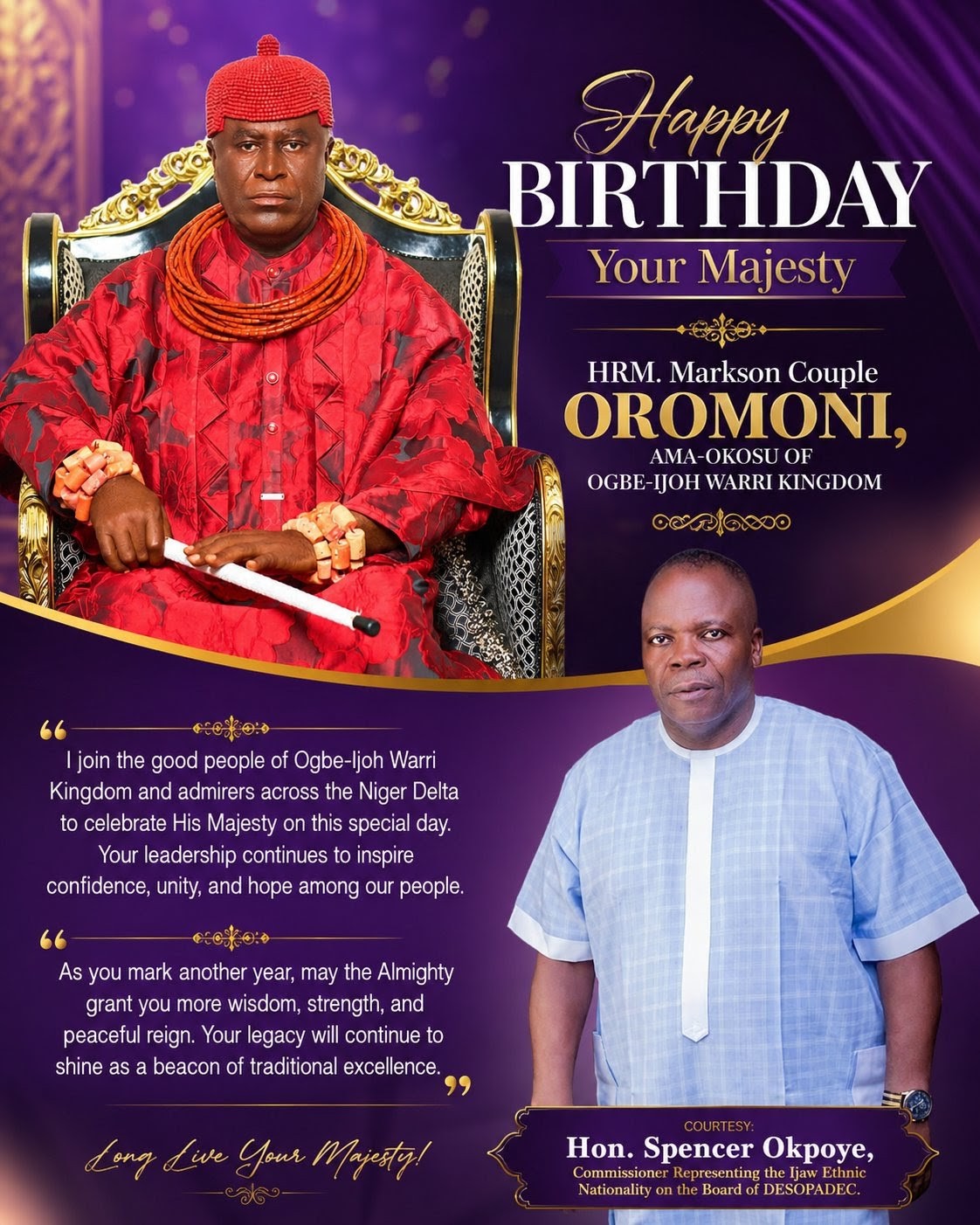
DESOPADEC Commissioner, Spencer Okpoye, Celebrates HRM Pere Ama~Okosu Of Ogbe~Ijoh Warri Kingdom on Birthday
Hon. Spencer Okpoye, the Commissioner representing the Ijaw ethnic nationality on the Board of the Delta State Oil Producing Areas Development Commission (DESOPADEC), has congratulated the Pere Ama-Okosu of Ogbe-Ijoh Warri Kingdom, His Majesty King Couple Markson Oromoni, MONBENE III, on the occasion of his birthday. In a goodwill message, Hon. Okpoye noted that the celebration of the monarch’s birthday reflects the deep respect and admiration he commands across the Ijaw nation and the wider Niger Delta region, adding that his leadership has continued to provide stability and a sense of direction for the kingdom. He noted that the birthday of the revered king, King Couple Markson Oromoni, presents another opportunity to reflect on his contributions to the stability and progress of the Ogbe-Ijoh Kingdom. According to him, the monarch’s reign has remained impactful, especially in strengthening harmony among kingdoms and supporting developmental cooperation in the Ijaw oil producing communities. Hon. Okpoye, in his birthday message, stated: > “I join the good people of Ogbe-Ijoh Warri Kingdom and admirers across the Niger Delta to celebrate His Majesty on this special day. Your leadership continues to inspire confidence, unity, and hope among our people.” > “As you mark another year, may the Almighty grant you more wisdom, strength, and peaceful reign. Your legacy will continue to shine as a tool of traditional excellence.” The DESOPADEC Commissioner reaffirmed his respect for traditional institutions, noting that their role remains vital in sustaining peace and grassroots development across oil-producing communities.
6/19/2026, 12:50:38 PM
views 1777
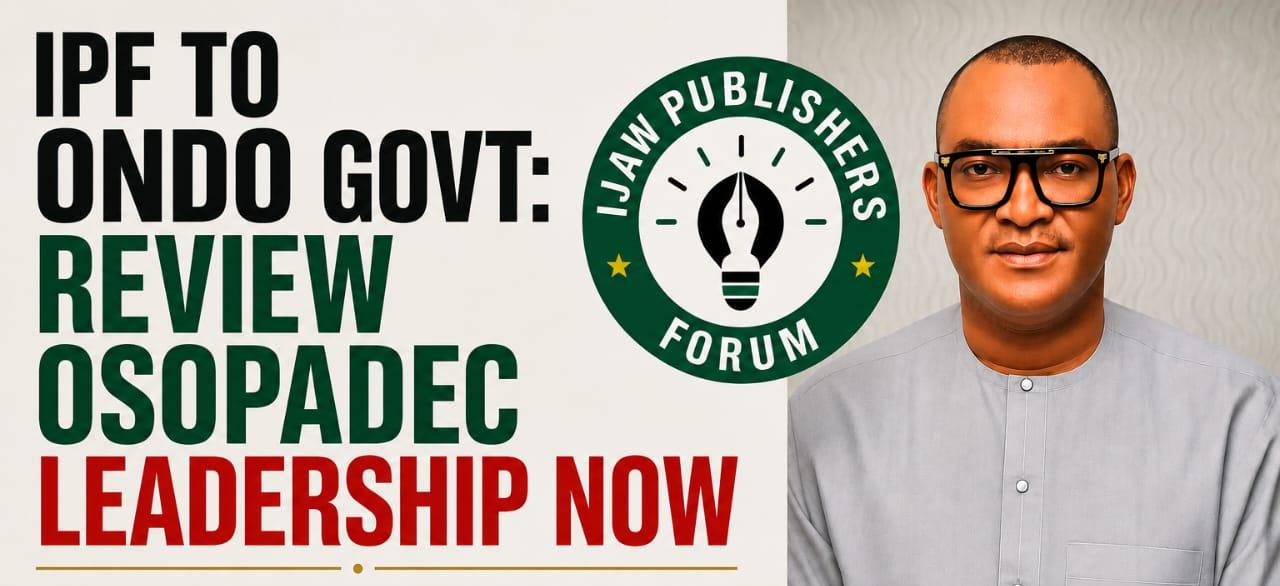
IPF To Ondo Govt: Review OSOPADEC Leadership Now
The Ijaw Publishers Forum (IPF), Worldwide, has called on the Ondo State Government to reassess the leadership of the Ondo State Oil Producing Areas Development Commission (OSOPADEC), citing what it described as limited developmental progress one year after the appointment of its Chairman, Prince Biyi Poroye. In a statement signed by its President, Comrade Austin Ozobo, the Forum expressed concern over the slow pace of development within the Commission’s mandate areas, particularly Ilaje and Ese-Odo Local Government Areas, despite the numerous challenges facing oil-producing communities. IPF noted that residents continue to grapple with poor infrastructure, inadequate healthcare services, lack of potable water, shoreline erosion, environmental degradation, and limited economic opportunities. It added that although several projects have been announced and inspected, many communities are yet to experience completed projects with meaningful impact. The group therefore urged the Ondo State Government to carry out a comprehensive evaluation of OSOPADEC’s performance over the past year to determine whether it is effectively delivering on its mandate. IPF also called for renewed commitment to addressing the socio-economic and infrastructural challenges in the region, stressing that the people of Ilaje and Ese-Odo deserve sustainable development, improved public services, and broader economic opportunities. The Forum maintained that strengthening or reviewing the Commission’s effectiveness would help restore public confidence and accelerate development across oil-producing communities in the state.
6/19/2026, 10:02:47 AM
views 9580
IPOB Suspends Nnamdi Kanu As Leader
The proscribed Indigenous People of Biafra (IPOB) has announced the suspension of the offices of its leader, Indigenous People of Biafra leader Nnamdi Kanu, as well as the position of Director of Radio Biafra. The decision followed a full meeting of the IPOB Directorate held on Wednesday, during which the leadership examined intelligence reports relating to communications allegedly originating from Kanu while in Sokoto prison. This was contained in a statement released on Thursday and signed by Mazi Chikadibia Edoziem, Head of the Directorate of State of IPOB. The group stated that henceforth, a Directorate of State would take full responsibility for administering the organisation and managing its overall affairs. It further explained that IPOB was established by a collective of Biafrans in the diaspora rather than a single individual, stressing that no one person has the authority to dissolve the Directorate of State, which it described as the highest decision-making body of the movement. According to the statement, the action was taken out of concern that “unguarded communications from Sokoto prison to those in Biafraland has caused unnecessary arrests and death of IPOB family members in Biafraland.” The leadership also raised concerns that Kanu’s movements and visitors are closely monitored by the Department of State Services (DSS), while warning about alleged plans by some individuals to form a new militia that could spark renewed violence in the region. It added that the suspension was intended to “prevent unchecked actions, reckless assumption of authority and unguarded utterances from resulting in the reckless arrests, torture and needless death of Biafran youths.” The group also stated that any criminal conduct carried out in the name of the suspended office would no longer be attributed to IPOB, stressing that it “shall henceforward not be held accountable for actions of individuals or groups of individuals not holding any active position within IPOB.” This development comes amid reports that Kanu had earlier dissolved the third administration of the Directorate of State (DOS) within the organisation. He was also reported to have inaugurated a fourth DOS administration and appointed US-based Mazi Chris Nwaogu as the new head, assigning him responsibility for the day-to-day coordination and management of IPOB activities under his authority, according to spokesperson Emma Powerful. The DOS was originally created by Kanu in 2012 as the administrative arm of IPOB. It has previously been led by Dr. Justin Akujieze in the United States, Mazi Uchenna Asiegbu in Spain, and Chika Edoziem in Switzerland, who headed the third administration after his appointment in March 2017 during Kanu’s detention at Kuje Prison.
6/19/2026, 8:09:40 AM
views 5036
FG Sets Up Presidential Task Force Against Ebola
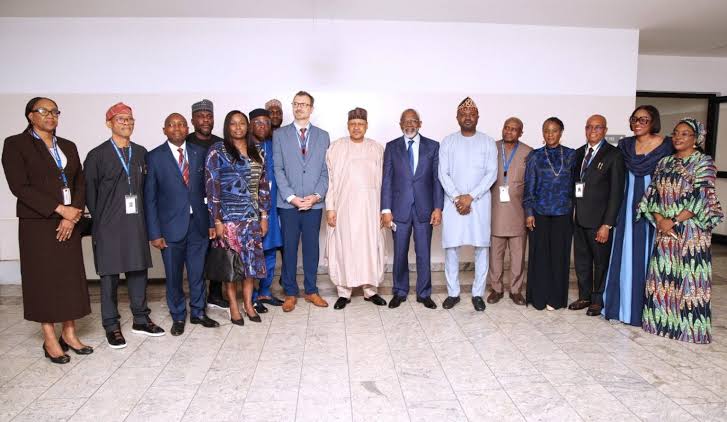
The Federal Government has inaugurated a Presidential Task Force on Ebola Virus Disease Preparedness as part of efforts to strengthen the country’s readiness against any potential outbreak. The Chief of Staff to President Bola Tinubu, Femi Gbajabiamila, inaugurated the task force on Thursday in Abuja, emphasizing the need for early intervention to prevent a recurrence of the 2014 Ebola outbreak in Nigeria. “We did the inauguration today on the preparedness of Nigeria for the Ebola virus disease. We’ve covered a lot of ground. “Right now, there’s no reported case, which is good news, and that’s why all hands have to be on deck to make sure the measures we are taking are preventive, not curative,” he said. Gbajabiamila noted that the government is determined to stay ahead of any potential threat rather than reacting after an outbreak has occurred. “We don’t want to be in the situation we were last time, where we had a carrier in the country and we’re all running helter-skelter,” he added. He disclosed that the task force has established dedicated teams to oversee critical areas such as disease surveillance, border monitoring, and emergency response coordination. According to him, unlike previous preparedness measures that largely concentrated on airports, the current strategy places greater emphasis on land borders and unofficial entry routes. He explained that the expanded approach is necessary due to increasing cross-border movements through land routes, adding that agencies such as the Nigeria Immigration Service, the Border Control Development Agency, and border communities are actively involved in the initiative. The Director-General of the Nigeria Centre for Disease Control and Prevention (NCDC), Dr Jide Idris, confirmed that health screening and monitoring measures have already been reinforced at key points of entry across the country. He added that the preparedness framework integrates the efforts of multiple government ministries and state authorities to ensure Nigeria remains protected from the virus.
6/19/2026, 7:34:13 AM
views 9062
Copy South Africa – Peter Obi Decries Nigeria’s Unproductive Borrowing
The presidential candidate of the Nigeria Democratic Congress (NDC), Peter Obi, has urged Nigeria to adopt South Africa’s approach to borrowing, describing it as a model of responsible and accountable debt management. Obi made the call on Thursday in a post on his verified X handle, stressing that borrowing in itself is not a problem, but that transparency in the utilisation of borrowed funds is what matters most. The former Anambra State governor said South Africa’s borrowing pattern exemplifies what accountable borrowing should look like, noting that the objectives are clearly defined, the projects are identifiable, and the anticipated benefits to citizens are measurable. According to him, such investments have a direct impact on improving living standards, boosting productivity and driving economic growth. “I have consistently maintained that borrowing, in itself, is not a bad thing. Every nation borrows. The critical issue is not the act of borrowing, but what the borrowed funds are used for and whether citizens can clearly see and measure the impact of such borrowing in their daily lives. “There is a lot to learn in the open and transparent manner in which South Africa handled its recently secured $1 billion loan from the New Development Bank, with a clearly defined purpose. “This is indeed what accountable borrowing should look like; the purpose is clear, the projects are identifiable, and the expected benefits to citizens are measurable. Such investments directly improve living conditions, enhance productivity, and stimulate economic growth. “In Nigeria, however, the opposite is the case: public debt has risen dramatically under the current administration, and its deployment is shrouded in secrecy from the people who will indeed pay back the loan. Today, our total public debt has increased from about ₦87 trillion in 2023 to nearly N200 trillion. “Yet, despite this unprecedented accumulation of debt, Nigerians are often left without a clear and detailed account of how these borrowings are being deployed to improve critical sectors such as education, healthcare, power, security, and infrastructure. “Borrowing must never become an end in itself. Every loan obtained in the name of the Nigerian people must be tied to specific, productive investments capable of generating economic value, creating jobs, reducing poverty, and improving the welfare of citizens. “Good governance demands transparency and accountability. The government must be able to clearly explain what was borrowed, where it was invested, and what measurable outcomes have been achieved. The ordinary Nigerian should be able to see and feel the benefits of every debt incurred on their behalf. “At a time when millions of Nigerians are struggling with rising costs of living, unemployment, insecurity, and declining purchasing power, fiscal discipline and prudent management of public resources are no longer optional; they are imperative. “Every borrowing decision should answer one simple question: How does this improve the life of the ordinary Nigerian? If that question cannot be convincingly answered, then we risk merely transferring today’s burdens to future generations,” he wrote.
6/18/2026, 6:44:36 PM
views 6746
FG Dismisses Reports of New Telecoms, Fuel Taxes Following IMF Recommendations
The Federal Government on Wednesday refuted reports claiming it had adopted or was considering the introduction of new taxes on telecommunications services and petroleum products in response to recommendations contained in the latest International Monetary Fund (IMF) Article IV Consultation Report on Nigeria. The government described the reports as a misrepresentation of the IMF document, stressing that they did not reflect its policy direction and that no new taxes were being contemplated for either the telecommunications or petroleum sectors. In a statement issued by the Head of Information and Public Relations Unit of the Federal Ministry of Finance, Efe Ovuakporie, the government emphasized that recommendations contained in the IMF report were advisory in nature and should not be construed as official government policy. **“The government has dismissed reports suggesting that it has adopted or is considering new taxes on telecommunications services and petroleum products following the publication of the International Monetary Fund Article IV Consultation Report on Nigeria,”** the statement said. The clarification follows recent reports that the IMF had proposed several revenue-generating measures aimed at strengthening government finances and improving fiscal sustainability. According to reports, the IMF recommended the introduction of taxes on fuel products and telecommunications services as part of broader efforts to boost government revenue and create fiscal space for development projects and social programmes. However, the Federal Government maintained that taxation decisions can only be taken through constitutionally established legislative procedures and must align with national priorities and prevailing economic conditions. According to the ministry, **“The IMF Article IV Consultation Report contains the Fund’s assessment of Nigeria’s economy as well as recommendations for consideration by the authorities. Those recommendations do not amount to government policy and are not binding on Nigeria.”** It further stated, **“Decisions on tax matters are taken through established constitutional and legislative processes and are guided by national priorities and prevailing economic realities.”** The government also clarified that the Value Added Tax (VAT) waiver on petroleum products remains in effect and has not been withdrawn. The statement explained that although existing legislation makes provision for a fuel surcharge, such a charge can only take effect through a ministerial order and publication in the Official Gazette. **“It also noted that although existing legislation provides for a fuel surcharge, such a measure can only take effect through a ministerial order and publication in the Official Gazette. No such process is under consideration,”** the ministry stated. The government noted that maintaining the waiver and suspending related charges has helped cushion the impact of fluctuations in global energy prices on households and businesses while ensuring relative stability in domestic fuel prices. **“The continued suspension of these charges has helped cushion the effect of global energy price fluctuations on households and businesses while keeping domestic fuel prices relatively stable,”** it added. On the telecommunications sector, the government explained that the excise duty introduced before 2023 had already been repealed under the country's newly enacted tax laws and is no longer applicable. **“The Government further clarified that the telecommunications excise duty introduced before 2023 has been repealed under the new tax laws and is therefore no longer applicable,”** the statement said. The ministry therefore urged Nigerians to disregard reports suggesting that fresh taxes were being proposed for telecommunications services or petroleum products. **“Against this backdrop, reports claiming that new taxes are being planned for telecommunications services or petroleum products are not factual and should be disregarded,”** it stated. Reaffirming its commitment to economic reforms, the Federal Government said its focus remains on policies that encourage growth, strengthen revenue administration and attract investment, rather than imposing additional tax burdens on citizens. **“The Federal Government remains focused on reforms that promote economic growth, improve revenue administration and create a more competitive environment for investment and job creation. The emphasis remains on expanding economic activity, plugging leakages and improving efficiency rather than placing additional tax burdens on citizens,”** the statement added. The government also assured Nigerians that any future tax measures would be communicated through official channels and implemented in accordance with existing laws.
6/18/2026, 7:47:12 AM
views 7593
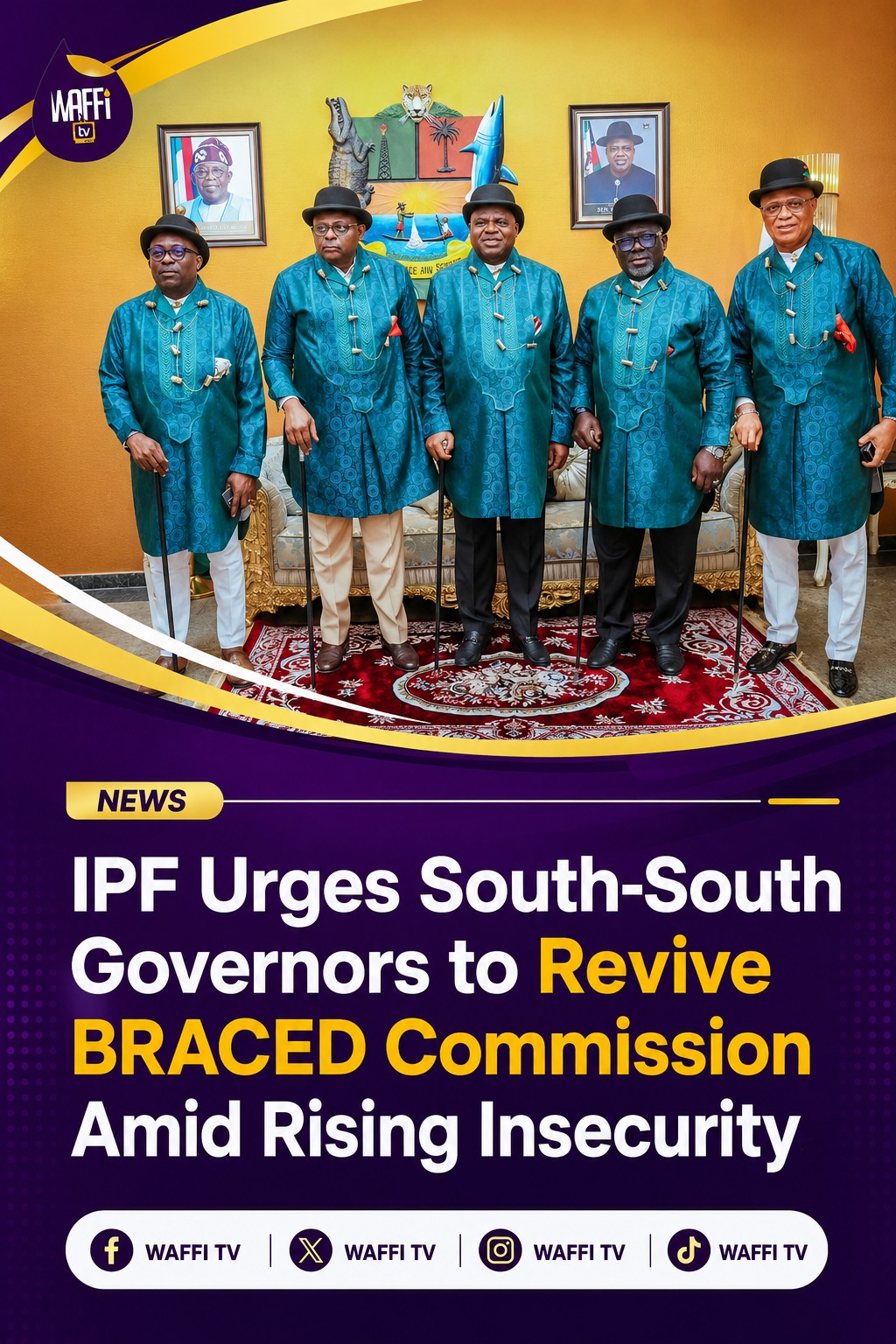
IPF Urges South~South Governors to Revive BRACED Commission Amid Rising Insecurity
The Ijaw Publishers’ Forum (IPF) has called on the governors of the six South-South states to urgently reactivate and adequately fund the BRACED Commission as part of efforts to address growing security concerns across the region. In a statement issued on Thursday and signed by its Secretary, Tare Magbei, the forum urged the governors of Bayelsa, Rivers, Akwa Ibom, Cross River, Edo and Delta states to adopt a coordinated regional approach to tackling insecurity before criminal activities become deeply entrenched in the region. The forum expressed concern over reports indicating that kidnapping, banditry and other violent crimes are spreading beyond their traditional strongholds to other parts of the country. It noted that recent incidents have prompted discussions on state policing reforms as authorities seek new strategies to combat the worsening security situation. According to the IPF, the South-South should view these developments as a warning signal and take proactive measures to prevent the infiltration of criminal elements into the region. The group observed that parts of the South-South, including Delta State, already face security pressures from neighbouring states, while the Niger Delta continues to grapple with kidnapping, cult-related violence, oil theft and other forms of organised crime. It warned that criminal networks operate across state boundaries and could easily expand their activities without a unified regional security framework supported by intelligence sharing, maritime surveillance and coordinated emergency response mechanisms. The forum described the continued inactivity of the BRACED Commission as unacceptable, stressing that the body was originally established to promote regional integration, development and security cooperation among South-South states. IPF therefore called for the immediate convening of a South-South Security and Development Summit to facilitate the revival of the commission and strengthen regional collaboration. The group also advocated the establishment of a regional security coordination centre, improved intelligence gathering and a collective strategy to combat terrorism, banditry, kidnapping, sea piracy and economic sabotage. Emphasising the economic importance of the South-South region to Nigeria, the forum said critical infrastructure, communities, schools, markets, roads and oil facilities must be protected from emerging security threats. It urged the governors to act swiftly, warning that failure to respond to early warning signs could have serious consequences for the region's security and development.
6/18/2026, 7:38:04 AM
views 2264
FG, States, Others Share N2.300trn May 2026 Revenue
The Federation Account Allocation Committee (FAAC) has distributed a total of N2.3 trillion to the Federal Government, state governments, and local government councils for May 2026. This was disclosed by the Director of Press and Public Relations in the Office of the Auditor-General of the Federation (OAGF), Mr. Bawa Mokwa, in a statement issued on Wednesday in Abuja. Mokwa stated that the allocation was approved during the June 2026 FAAC meeting held in the Federal Capital Territory. He explained that the N2.3 trillion distributable revenue consisted of N1.611 trillion in statutory revenue and N688.785 billion generated from Value Added Tax (VAT). According to him, a communiqué released after the meeting showed that the total gross revenue available for May 2026 stood at N3.395 trillion. He added that deductions for the cost of revenue collection amounted to N123.546 billion, while transfers, interventions, and refunds totaled N971.610 billion. The communiqué further revealed that gross statutory revenue for May 2026 was N2.651 trillion. **“This was higher than the sum of N2.378 trillion received in the preceeding month by N273.623 billion.** **“Gross revenue of N743.668 billion was available from the Value Added Tax (VAT) in May 2026.** **“This was lower than the N806.617 billion available in the month of April 2026 by N62.949 billion.** From the total distributable revenue of N2.3 trillion, the Federal Government received N818.680 billion, while state governments got N759.141 billion. The 774 local government councils shared N534.277 billion, while oil-producing states received N188.132 billion as derivation revenue, representing 13 per cent of mineral earnings. On the N1.611 trillion statutory revenue allocation, the Federal Government received N749.801 billion, states received N380.309 billion, and local government councils got N293.202 billion. In addition, the oil-producing states received N188.132 billion as derivation revenue. The communiqué also indicated that from the N688.785 billion VAT revenue, the Federal Government received N68.879 billion, state governments received N378.832 billion, while local government councils got N241.075 billion. Mokwa noted that revenue from Companies Income Tax (CIT), Capital Gains Tax (CGT), Stamp Duties (SDT), Petroleum Profit Tax (PPT), Hydrocarbon Tax (HT), Oil and Gas Royalties, and Import Duty recorded significant increases during the period. He, however, said collections from VAT, Excise Duty, and Common External Tariff (CET) Levies declined considerably in May 2026.
6/18/2026, 7:17:13 AM
views 8657
Install WAFFITV